
What is social proof?
Simple: It's the psychological phenomenon where people assume the actions of others reflect the correct behavior for a given situation.
Translation? If everyone else is doing it, it must be good.
But let me tell you what social proof is NOT:
❌ It's not just "get 5-star reviews and you're done"
❌ It's not a magic button that fixes a bad product
❌ It's not something only big companies can afford
Social proof is the mental shortcut your potential customer's brain takes to bypass the "Is this a scam?" filter and move straight to "Will this solve my problem?"
And in 2026? With the barrier to entry for starting a business lower than ever — and the noise/scam potential at an all-time high? Social proof isn't nice to have. It's survival.
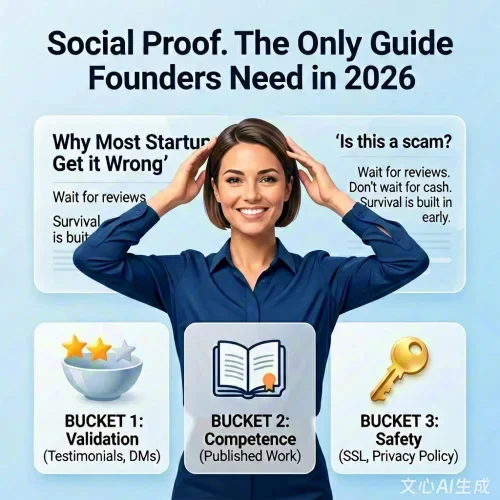
The 3 Buckets of Social Proof (According to Someone Who Has Literally 0 Customers)
I break trust signals into three categories. This framework comes from my own guide — yeah, the one I wrote while having exactly zero paid users:
| Bucket | What It Is | Example |
| Social Proof (Validation) | "Others have done this and survived" | Testimonials, DMs, user counts |
| Authority & Expertise (Competence) | "This person actually knows what they're talking about" | Published books, podcasts, certifications |
| Security & Reliability (Safety) | "This isn't going to scam me" | SSL, privacy policy, visible contact info |
Most founders only focus on Bucket 1. That's why they're stuck begging for testimonials they don't have yet.
The smart ones? They stack all three — even when they're small.
Why 90% of Startups Get Social Proof Wrong
They wait.
They wait for their first customer to leave a glowing review. They wait for a tech blog to feature them. They wait for G2 to notice them.
By the time they have "real" social proof, they've run out of cash.
Here's what I do instead (at BuildRunKit, with 0 paid users):
- I go public with the numbers. "20 users, 0 paid customers, still shipping." That's social proof.
- I show the journey. My podcast, my YouTube, my "Build in Public" logs. That's authority.
- I make the boring stuff visible. Privacy policy, contact info, "Powered by PostgreSQL" badges. That's security.
👉 See the full breakdown in our Trust Signals guide →
🎙️ Want to Hear Me Break This Down?
I recorded a full podcast episode on this exact topic: "How to Look Like a $10M Company When You're Just One Person."
It's on The Frenzied Founder channel (that's me — Brent, the BuildRunKit founder).
🎁 Free Ebook: The Complete Playbook
I put everything I know about social proof, trust signals, and building credibility from zero into one free guide.
📥 Download "Trust Signals for Trustworthy Businesses" →
No email gate. No "enter your credit card." Just the playbook.
| Catch up on this subject:
Plan. Build. Run.